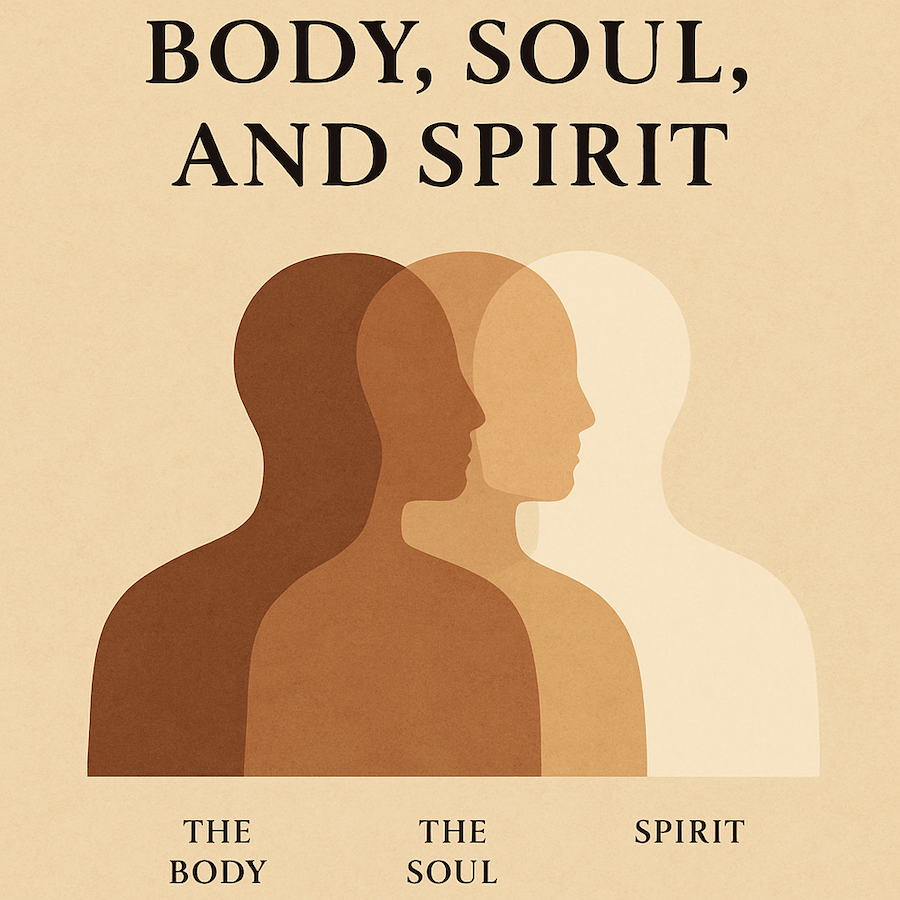
How to recognize body signals, soul responses, and spirit guidance
As some of you may have read in my embodiment post, you may already have a sense of how important it is to connect with the body.
The other day during meditation, I found myself silently talking to my body—simple phrases like, “How do you feel tonight?” “Where are you achy right now?” “What’s bothering you in your shoulder?”
As I did this, something in me became curious.
What part of my consciousness is actually trying to connect with my body?
Is it my mind talking to my body, even though my mind often feels separate from my physical self?
Is it my soul trying to reconnect?
What is this inner dialogue, really?
Then there’s another familiar experience—an inner monologue that can feel like a debate between two parts of yourself.
“I want to go to this event.”
“No, I really don’t. I’d rather stay home.”
“It would be good for me to socialize.”
“I don’t want to socialize.”
If you’re anything like me—and like a large portion of the population—you’ve experienced similar inner conversations.
This curiosity led me to explore the experience more deeply: connecting to different parts of myself. What is the body, separate from the soul and separate from spirit? How do they interact or overlap? I went down a quiet rabbit hole, investigating the differences and similarities—not to label myself, but to listen more accurately.
Why This Topic Matters
Healing happens most effectively when we address the correct layer.
So often, we try to think our way out of body sensations, spiritually override emotional wounds, or push ourselves forward without realizing our nervous system doesn’t yet feel safe. When we don’t know which part of us is speaking, we can easily confuse protection with truth, or intuition with anxiety.
Learning the difference between body signals, soul responses, and spirit awareness has helped me approach healing with more gentleness, clarity, and trust. Instead of overriding parts of myself, I’ve learned to listen to them differently. That’s why this topic matters to me—and why it may matter to you, too.
The Body (Physical Form + Nervous System)
The body is the most physical and tangible part of our existence. It is responsible for safety, sensation, survival, and regulation. It keeps us alive, moving, breathing, and functioning—often without us needing to think about it at all.
The body communicates through sensation rather than language. Tension, fatigue, pain, shallow breathing, digestive changes, or a sense of overwhelm are all ways the body speaks. When the body is ignored or overridden, these signals often grow louder until they are noticed and tended to.
Thoughts arising here often feel looping, urgent, anxious, over-explained, or overly analytical. They are not wrong—they are protective. They are trying to keep us safe.
But protection is not the same as guidance.
The Soul (Emotion, Identity, and Memory)
The soul is often confused with spirit, but it is distinct.
The soul acts as the bridge between spirit and body when interpretation is needed. It holds our emotional experience, identity, memory, and meaning. I find it helpful to view the soul through three expressions—not as fixed anatomy, but as a working lens for understanding experience.
There is our conscious awareness—the thinking and feeling self that interprets information and makes choices. There is also a subconscious layer, which is often the most active. This layer holds emotional memory, trauma and protection patterns, instinct, and intuitive body memory. Because it is deeply connected to the nervous system, much of what arises here is felt rather than thought.
Many messages—whether emotional, intuitive, or energetic—can move through this subconscious layer and show up in the body as gut feelings, tingles, tightness, sinking sensations, or a sense of expansion or contraction.
Then there is what many refer to as the higher self—the clearest, most integrated expression of the soul and the part most aligned with spirit. Guidance from this place feels calm, steady, and truthful. It doesn’t rush or pressure. It has persistence, but not urgency.
It’s important to say this clearly: soul guidance can include fear or protection. Not every inner voice from our soul is peaceful, and that doesn’t make it wrong. It may simply be responding from past experience rather than present truth.
The Spirit (Essence and Awareness)
Spirit is our pure essence. The highest vibration.
It is the most vast, still, and untouched part of us—the part closest to Source, God, or universal life energy, however you understand that. Spirit exists beyond polarity. It is neither positive nor negative. It simply is.
Spirit is awareness itself. It does not react or force. It does not override the body or bypass emotion. Instead, it expresses through the soul and body.
Spirit is what gives life its aliveness.
Why These Layers Exist
Spirit is the highest vibration—vast and subtle. On its own, it cannot create form.
The soul translates spirit into lived experience, and the body gives that experience density, sensation, and expression. The body is where we experience life’s polarities—joy and sorrow, pleasure and pain, expansion and contraction. In this way, the body becomes the manifestation of the soul’s experience.
Some information is meant to regulate and organize the system, and this can move directly from spirit to body. Other information needs to be understood, integrated, or healed, and must pass through the soul.
Spirit organizes.
The soul interprets.
The body executes.
The route is determined by whether interpretation is required. This is why different experiences require different kinds of listening.
Why This Is Important to Understand
When we are out of alignment with spirit, we often experience anxiety, urgency, restlessness, or mental looping. We may feel pressure to figure things out quickly, difficulty settling into our body, or a sense of being “off” without knowing why. These experiences usually reflect a nervous system or emotional self trying to protect us—not true spiritual guidance.
When thoughts, emotions, or sensations rise into awareness, understanding these layers allows you to pause and ask a simple but powerful question: Which part of me is speaking right now?
The body and subconscious soul often carry protection patterns formed through lived experience. Anxiety, urgency, doubt, or pressure usually arise from a part of us trying to keep us safe. These voices are understandable—but they are not always current truth. They may no longer be needed.
Guidance from the higher self or spirit feels different. It may point toward something that needs shifting, but it doesn’t feel panicked or pressuring. It arrives calmly, clearly, and steadily, with a sense of organization rather than urgency.
Intuition does not shout.
It does not rush.
Anxiety is a wound speaking.
Truth arrives quietly.
Why Talk Therapy or Spiritual Practice Alone Can Fall Short
Talk therapy can be deeply helpful, but insight alone doesn’t always change how the body feels. If the nervous system is still in a state of threat, emotional healing can stall, no matter how much we understand our patterns.
In the same way, spiritual practices can feel distant or ineffective when the body doesn’t feel safe. Messages from the soul and spirit move through the nervous system. When the body is overwhelmed or guarded, that information has nowhere to land.
It’s through feeling safely embodied that emotional understanding and spiritual insight begin to integrate into lived wisdom.
Integration: Working With All Three
No layer is superior.
They coexist at the same time, in the same space.
The body needs safety.
The soul needs acknowledgment.
The spirit needs stillness.
A Gentle Practice
Take time to feel into your body and nervous system, your soul at its different expressions, and your spirit. Notice how each feels when you tune in. Notice which feels steady, which feels protective, and which feels quietly true.
Many people believe soul or spirit healing has to be intense or deep. That isn’t accurate. Sometimes the most profound healing happens through subtle listening.
Closing Reflection
The soul and spirit can often feel far away, or so deep that it seems difficult to reach or heal them.
You don’t have to go deep enough to find them.
You only have to be still enough to feel them.
When you feel confused or anxious about a decision, it is often your mind or a wounded part of the soul trying to protect you from fear or past experience. When a subtle, calm knowing arises—without pressure or urgency—that is your higher self and spirit offering aligned guidance.
Messages from your highest self and spirit will never come through as urgency, fear, or worry.
Start where you are. You don’t need to be anywhere else. Be gentle with yourself. You are not broken—you are on a healing journey of self-discovery.
For an easy embodiment practice, you can read my previous blog here:
How-To-Become-More-Embodied.
If this blog resonates and you’d like support connecting more deeply with your body, soul, and spirit, you can reach me at amberboynton.com.
Amber Boynton, APP, EPP, LMT
Integrative Healing Practitioner



Leave a comment